
Case Study 3
Infant Weaning Down on HFNC
Patient Description:
- Ex-preterm, ~2.5kg
- Weaning down HFNC 4 → 3 → 2cm H2O
- New oxygen requirement on weaning
Concern: Uncertainty over wean not being tolerated vs. HFNC prongs not meeting required flow rate

Measuring the pressure on High Flow 2L/min showed the PEEP was ~1 cm. The pressure fell below zero on inspiration, showing that 2L was not sufficient to meet maximal inspiratory flow rate. The wide swings in pressure suggest the prongs may in fact have been impeding both inspiration and expiration.
Comparison to a similar infant also on 2L of flow but with smaller prongs shows both a lower PEEP but also lower swings in pressure. Smaller prongs increase the % leak, decreasing the PEEP. Smaller prongs also decrease obstruction to flow during inspiration — if gas flow rate doesn’t meet maximal inspiratory flow rate, the infant needs to be pulling in air from the environment.
Large prongs with minimal space around them, combined with an insufficient maximal inspiratory flow rate can potentially hinder rather than support breathing! Smaller prongs cause less obstruction to expiration — remember that unlike with CPAP, infants cannot breathe out through the high flow circuit, they can only breathe out around the high flow circuit.
HFNC 2L
Large Prongs
(Case Study Patient)
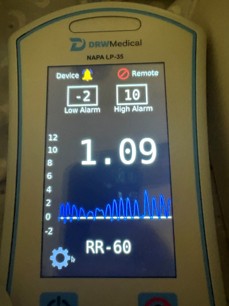
HFNC 2L
Small Prongs
(Comparison Patient)
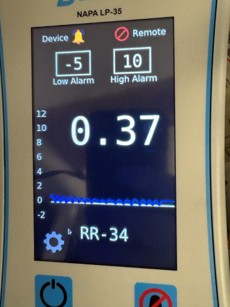
Measures from a different infant on 2L flow with smaller prongs are shown (right) for comparison